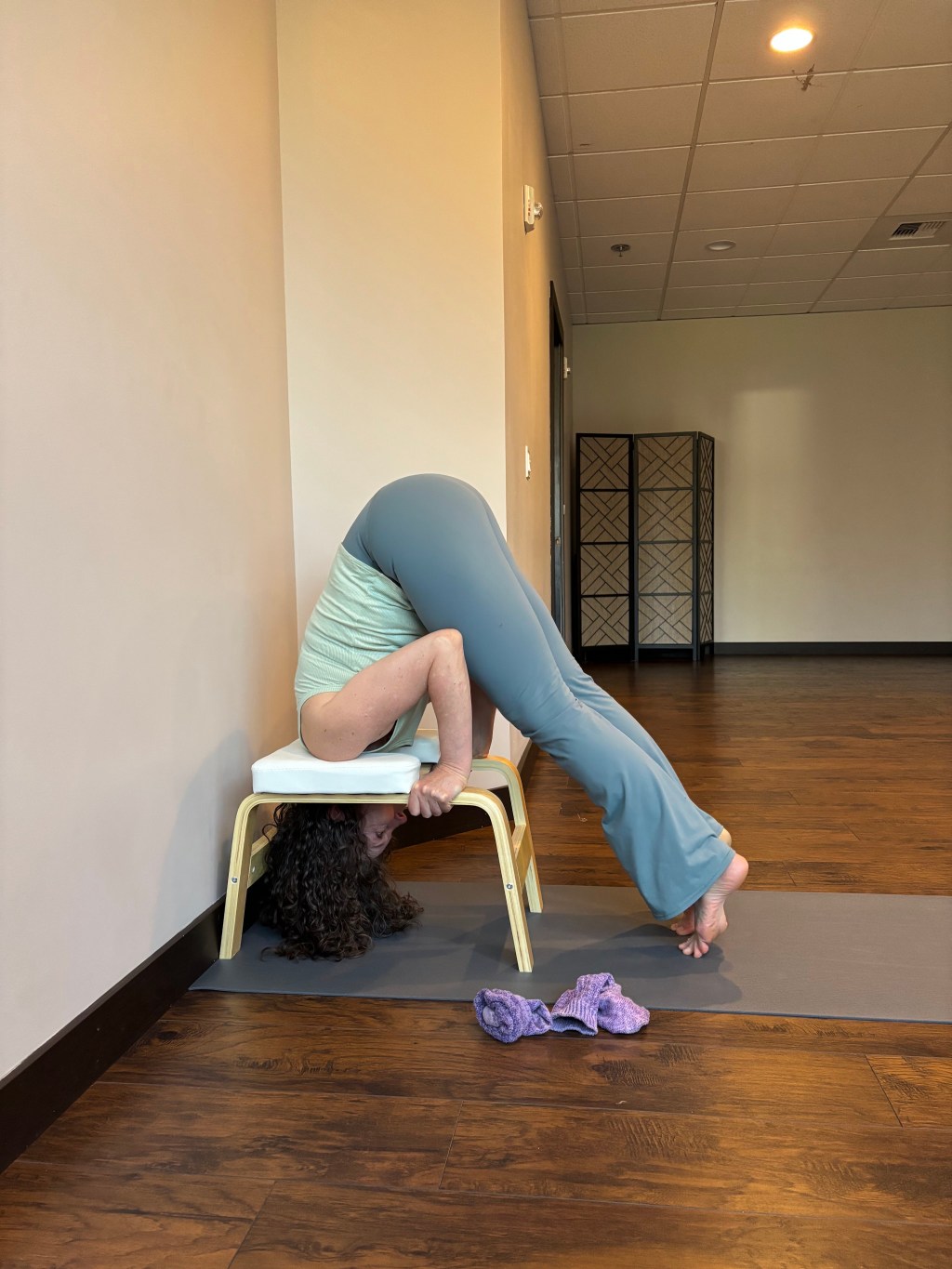
I stood on my head for the first time ever recently. Most of my life, I thought it was something I could never do.
I feel proud of reaching this milestone. I traveled a long road I traveled to get my feet above my head. I’ve spent most of my life unable to do a headstand. Here’s what my journey to headstand taught me.
First, I learned I needed to change my thought patterns
I was one of the last kids to get picked for team sports in P.E. My childhood nickname, “Messlissa Klutz,” speaks to my level of percieved coordination. I spent years thinking I was clumsy, incapable of things like standing on my head.
I discovered yoga 20 years ago. I loved how the movement and breathwork made my body feel, but if an instructor suggested headstand, I shook my head.
“I’m scared of falling,” I told them. “And I’m not very coordinated.”
After I had a total hip replacement in 2013, and my fear of falling increased.
“What if I fall and hurt something else?” I would think to myself.
In the fall of 2024, I took yoga teacher training. During training, I learned a Sanskrit word, samskara, that describes the paths and patterns that we cling to without questioning them. I struggled to observe my thought patterns. Sometimes I could catch myself telling stories about the past, present or future.
In training, I learned to do many things that I never thought possible, such as bakasana, or crow pose, an arm balance where you rest your knees on the backs of your triceps and lift your body up. I also let go of the idea that headstand was out of reach. I decided in January of 2025 to work on getting my feet up over my head.

I learned it’s okay to scale back.
I had originally hoped to learn handstand this year. A fractured foot in February foiled my plan, but through physical therapy I slowly returned to yoga. I remained in physical therapy until June. I decided that achieving handstand this year might be unrealistic. Instead, I set my sights on headstand.
I learned to persist.
I researched drills for headstand. I took an inversion workshop. I spent 10 minutes a day a few days a week working on getting closer to getting upside down.
I flirted with being inverted.
I wrapped my fingers around the outsides of opposite elbows and planted them on the floor. Keeping elbows pinned to the ground, I moved my hands to form a cup for the back of my head, my bottom pinky finger tucked inside. I cradled the crown of my head to the floor between my hands. I sent my hips towards the sky. I straightened my legs and tiptoed my feet closer to my face, working on bringing my hips above my head.
I learned to path to headstands is paved with not doing headstands.
For months, my feet never left the floor. I struggled to feel where my hips were in the space above me, so I took short videos of myself and made adjustments. The videos revealed that my hips didn’t get directly over my head and shoulders, even though I had thought they did.
I practiced about 10 minutes on most days, and after a few weeks, my head, spine and hips formed a straight line, upside down.
Now all I needed was to get my feet into the air. I found myself struggling to do that on my own.
I learned to ask for and receive help.
I told Janet, the studio owner where I teach at Yoga in the Center, that I was practicing drills to learn headstand. She snuck me opportunities to practice in classes.
One day when I came to teach, she said, “Melissa, I have a surprise for you.”
I followed her into one of the practice rooms, where she had set up a specialized stool with an opening for your head. She showed me how to use it and watched as I tried it.
“Bring your right leg straight, up, then touch down briefly and kick up,” she said. I did, and suddenly I was upside down, feet above my head for the first time.

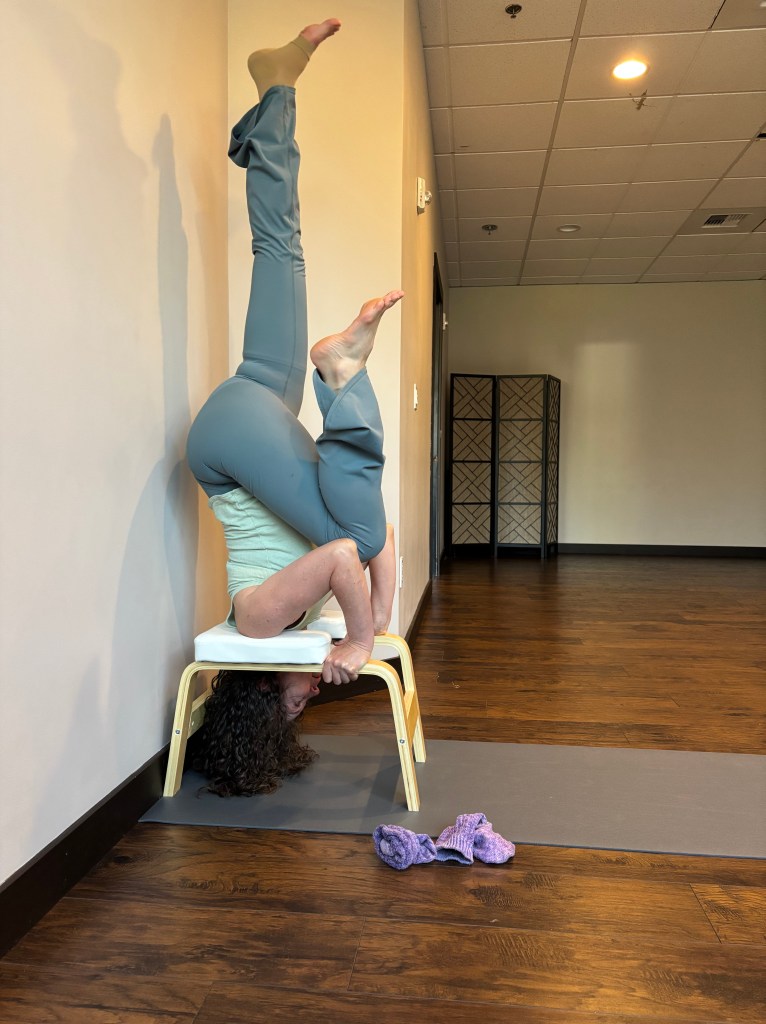
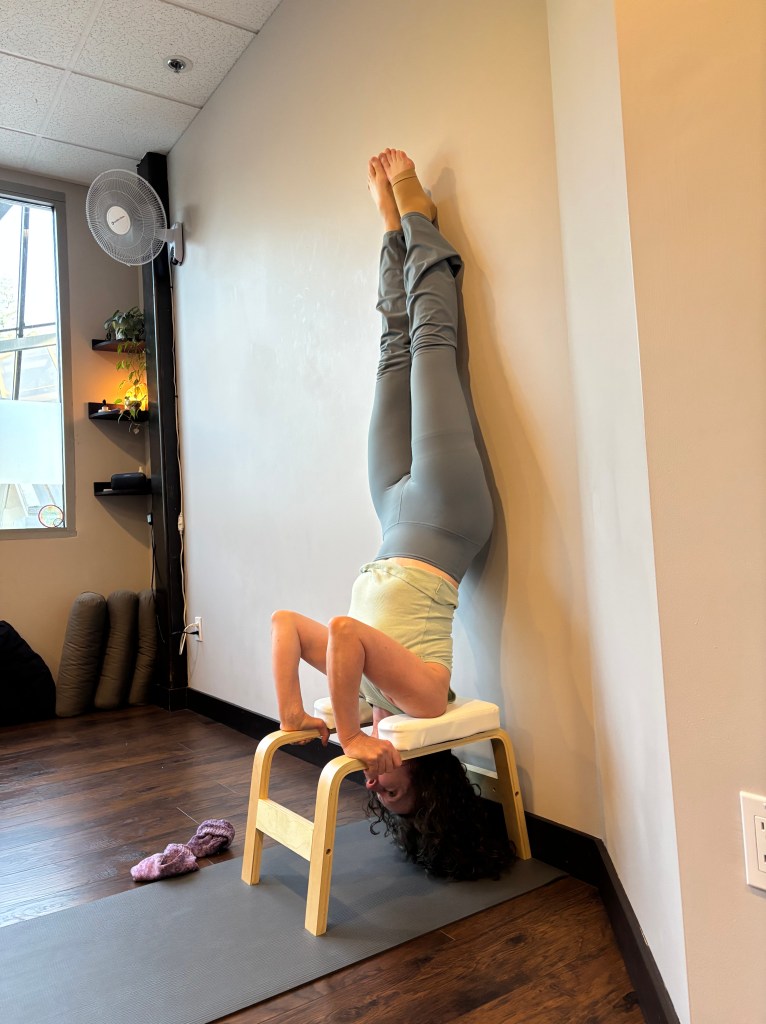
Soon after, I became able to do headstand using the wall for feedback. Now I try to practice every few days.
I learned I could apply my headstand journey to other parts of my life.
So often, our triumphs get presented as if they magically happened, as if our talent and brilliance alone got us the promotion or allowed us to create a perfect piece of pottery or run a triathlon. We don’t talk about the hours of work, the setbacks, or the helpers. We don’t talk about the simple, yet also complicated, act of saying, “I believe I can do this.”
After 20 years of yoga practice, I finally believed that I could stand on my head. And through learning patience, persistence, practice and support, I did.
What is it that you need to believe you can do?
 Melissa Lutz Blouin
Leave a comment